Monday, February 27, 2012

Rick Santorum versus College Education


There's several stories (including here: http://2012.talkingpointsmemo.com/2012/02/michigan-tea-partiers-share-rick-santorums-fears-over-obamas-college-push.php) about Rick Santorum's recent remarks about the President's push for college education. Several of them are accompanied by comments from people who seem to think that college just makes socialists/communists/fascists/whatever out of young people. And liberal pundits are amazed that he's getting away with this, and keep referring to the Republican mainstream, and how they can't possibly support this guy.

Got news for them: he's not appealing to the rational mainstream voters- the sort of people who have historically been in charge of the GOP. He's appealing to the whackos- the ones who are swayed by simplistic, reductionist, narrow arguments. I know these people- I was one for way too many years than I'd like to admit. They get a set of jingoistic phrases and rattle them off, but they haven't the faintest of a flying fuck of an idea what our government actually does, much less how to do it. These are people who seldom travel, don't know anyone in another country (and here I must add Gay Country), and probably couldn't point out Iran on a map. They don't know what GNP stands for, or who's the head of the Fed. They also probably don't know that Rick Santorum was named as one of the most corrupt Senators in 2006.

These people are the modern incarnation of the Know-Nothings. Except it's not Catholics they're against now. It's anybody brown, or gay, or educated, or not very very very conservative 'Christian', or female, or 'Librul'... heck, a gay Latina Episcopalian with a graduate degree who votes Democrat would be a perfect storm for them- someone would surely have a stroke!

Maybe not everyone will want to go to college. But they need to be given the opportunity. Because the numbers are VERY clear- earning capacity for someone who had a high school diploma are higher than someone who dropped out, and someone with a college degree much higher still. If someone is going to have a job good enough that they can have the life Santorum says they should- with an at-home wife and enough kids to field a baseball team, they HAVE TO BE EDUCATED. The jobs you can do as a high school grad are not going to be that kind of income. Period.

And you know what? In Oregon you have to have a two year college degree with some serious math and engineering before you can even APPLY to the plumber's or electrician's apprenticeship program.

So Santorum can go suck it, because HE DOESN'T KNOW WHAT HE'S TALKING ABOUT.

Tuesday, February 21, 2012

Lenten Practices in Medieval Western Europe

(at left: some cooking not in Lent...) The Basics of Medieval Lenten Dietary Practices Historical Background Language- The Teutonic word ‘Lent’ meant ‘Spring Season’ The Latin term was ‘quadragesima’, the Romance language descendents were the French ‘carĂªme’. Italia ‘quaresima’, and the Spanish ‘cuaresima’, meaning 40 days or fortieth day. The Germanic term was ‘tessarakoste, meaning fortieth. Early Customs There were Biblical precedents for an observation of forty days, of a 40 day fast or a trial of forty days. They include: -the 40 days and 40 nights of rain during the Flood; -the 40 days that Moses spent on Mt Sinai with God (returning with the two tablets of the Law); -the 40 days that Jonah gave Nineveh to repent (which they did); -the 40 days and nights that Elijah spent on Mt Horeb, in fasting and prayer; -the 40 days Jesus spent in the desert in fasting and prayer (culminating in the Great Tempation). Tradition holds that Jesus spent 40 hours in the Tomb after his death, and then was present for 40 days between the Resurrection and his Ascension, followed by 40 days before Pentecost. For the first Christians there quickly became a 40 day observance, with 40 hours of fasting before Easter. The Early Church Observances The first three centuries show diverse practices of pre-Easter observances. There was a gradual development in the length and expression of the Lenten observance. Eusebius quotes St. Irenaeus’ letter to Pope Victor regarding a controversy in the timing of Easter and in the length of the fast– some observed 1 day, some 2, others several, and others 40 days and 40 nights. Rufinius’ translation (late 4th c.) claims that Irenaeus insisted on a fast length of 40 days. (Modern criticism suggests that Rufinius’ translation and views were fairly accurate; however, it appears that Irenaeus knew that there was no Apostolic origin to these traditions.) A few years later a controversy arose between Tertullian, who declared a light Catholic observance– “days on which the Bridegroom is taken away”, that is, Friday and Saturday of Holy Week; and the Montanist strict observance for a fortnight– xerophagiae– a ‘dry fast’ (though there is no indication of a 40-day fast). It appears that there is no 40-day fast previous to the Council of Nicaea, and no mention of Lent per se in St. Dioysius or Didascalia; there was Pascal fasting but not 40 days. The Apostolic Church apparently observed a weekly commemoration, not yearly– Friday of the Death of Christ, and Sunday of the Resurrection. This may have contributed to the wide divergence in practice through the end of the 2nd. Century. A yearly vs. weekly observance developed over time, with some fasting being shorter, but more strict and severe. The first mention of a 40-day fast is at the Council of Nicaea c. 325. There was still some question as to the time of observance, but Easter was definitely a moveable feast. St. Athanasiusin 331 entreated his flock to observe Lent for 40 days preliminary to Holy Week, with strict fasting during Holy Week, possibly a dry fast. (This was possibly as early as the 3rd c. as per Dionysius.) In 339 he noted that the fast of Alexandria suggested fasting “to the end that while all the world is fasting, we who are in Egypt should not become a laughing-stock as the only people who do not fast, but take pleasure in those days”. This was backed up by the alleged ‘Apostolic Constitutions’ and St. John Chrysostom, and is generally followed in Eastern tradition. As early as the 5th century, the Church Fathers were claiming Apostolic origins to their practices. St Leo (d. 461) declared that abstention would “fulfill with their facts the Apostolic institution of the forty days.” (“Ut apostolica institutio quadraginta dierum jejuniis impleatur”) Socrates Scolasticus (d. 433) and St. Jerome (d. 420) used similar language. (Modern scholars don’t agree with these Church Fathers regarding the origins of the observance.) In Rome in the 5th c. Lent was observed for 6 weeks, three of those actually fasting, exclusive of Saturday and Sunday. This seems to have not been continuous, but was the 1st, 4th, and 6th weeks, and may have been limited to baptismal candidates– a had a possible role in the development of the 40 day fast. The application of the number 40 is itself murky. It may have been a 40-day fast, or it could have been 40 fast days. In Egeria’s Peregrinato, Lent was observed in Jerusalem for 8 weeks, with Saturday and Sunday exempted, leaving five days a week x 8 weeks = 40 days. Yet many localities held to six weeks of fasting, Saturday and Sunday still exempted, as in St Ambrose’s “De Elia et Jejunio”. Pope Gregory the Great (c. 590-604) declared that in Rome there would be 6 weeks of 6 days = 36 days = a ‘spiritual tithing’ (10% of 365 days). Later desires for 40 days of fasting leads to the beginning of Lent on Ash Wednesday rather than the following Sunday. Apostolic observance of Holy Week is unclear, but an observance was present in Jerusalem at the end of the 4th century, and Egeria leaves a detailed account of that week. The official ending of Lent is not Easter Sunday, but after the Easter Vigil service on the previous night. The Basics of Fasting The Teutonic roots of the word ‘fast’ principally mean to hold, keep, observe, and to restrain one’s self. The early Latin term for Lent- ‘jejunium’, refers to an animal intestine which is always empty. Thomas Aquinas claims in his Summa Theologica that fasting is in opposition to the Fall, a sin of Gluttony. Fasting was seen through history as a signifier of purification, mourning, and penitence. It was an act of self-discipline– a private mortification, but also a public expression of the sins of society. The act of fasting and abstinence varies. The basic definitions are these: -a ‘natural fast’– fasting before communion; -a ‘moral or philosophical fast’, which an individual disposition but can include fasting as self-control in religious communities; the strictest use of the term denotes abstinence from food as fulfilling the dictates of natural law and the full perfection of ecclesiastical legislation. The Nature of the Lenten Fast The specifics of the act of fasting is as divergent as the dates of the Lenten traditions. The primary and most important abstention is from meat. Meat is tasty, and giving it up is a particular reminder of the Fall, and of God’s subsequent anger. A theologian named Socrates tells us of the 5th century practices: -abstention from the flesh of every living creature; while others refrain from all but fish, others eat birds as well as fish; -others abstain from fruit that has a hard shell, and eggs; -some eat only dry bread, others not even that; -some fast to the ninth hour (nones– about 3 pm), then partake of various kinds of food; -some eat uncooked food only. Epiphaniu and Palladius say that ordinary Christians sometimes have 24 hours without food, especially during Holy Week; those more austere pass Lent with only one or two meals a week. The ordinary rule for Lent was one meal a day in the evening (eventually settled at nones), with meat entirely forbidden, and in the early centuries wine was also forbidden. During Holy Week, or at the least on Good Friday, xerophagiae, as ‘dry fast’ was practiced– that is, dry food, bread, salt, and vegetables. In the early years there seems to have been no dairy prohibition, and occasionally eggs were allowed. However, Pope Gregory wrote to St Augustine of Canterbury in the early 7th century that Christians were to abstain from flesh meat and all things that come from flesh– milk, cheese, eggs, etc. This was later codified in the Corpus Juris. In the 8th century Theodulphus of Orleans declared that there was an abstinence for eggs and cheese, and not eating fish was a mark of exceptional virtue. There were occasional exceptions from the dairy restriction, in exchange to for contributions to the Church, particularly for building projects. This was sometimes known as the ‘Butterbriefe’ in Germany, and the ‘Buttertower’ in Rouen. The prohibition on milk and eggs, expressed modernly in the pancakes eaten on Shrove Tuesday, and the giving of eggs on Easter. Odd loopholes appeared, most notably the eating of ‘barnacle geese’, which supposedly grew on trees and were therefore fruit, and the eating of beavers, which some thought to be a kind of fish. It must be noted that Church authorities generally weren’t fooled by these claims. There were some relaxations of the fast. The basic list (no meat, eggs, milk) continues to be out of bounds, with only one evening meal, but the hours were somewhat flexible. Charlemagne ate as early as 2 pm, but some put off eating until Vespers (sunset). The introduction of the ‘collation’ in the 9th century (so named because the monks would snack while listening to the Collationes or ‘Conferences’ of Abbot Cassian read aloud, and the name stuck) allows the concession of a draught of water after manual labor, and then becomes the ‘parvias materiae’– a small snack that is not taken as a meal and did not break the fast (was adopted by Aquinas, etc.). Small quantities of food, up to 8 ounces or so, were permitted after the midday meal. However, Micrologus insists in the 11th century that eating before evening is not keeping the fast. From the 13th through the 15th centuries categories of exemption from the fast increased. Children, the old, the ill, pregnant or nursing mothers, pilgrims, beggars, and heavy workers were allowed allowances and were able to eat some forbidden foods. St. Clare, in the 13th century, was known for her especially rigorous fasting, but she did note that it significantly undermined her health. By that time the basic feeling was ‘don’t be stupid’– don’t compromise your health. It may be noted that beyond the theological implications of Lent, there were some basic issues of animal husbandry. In the early spring, much of the livestock was pregnant or nursing newborns– not a time to kill them for meat or to milk them for human consumption. Birds that laid eggs would be allowed to set a clutch and hatch them, providing the next year’s birds. The prohibitions on the consumption of meat, milk, and eggs indeed was a matter of practicality. The Food So what did they eat? FISH. A LOT OF IT. Grains, fruits and vegetables, and nuts. Soy was not yet known in Western Europe, and was not part of their diet. The consistent source of protein is fish and seafood. Careful planning was required to make the fast the least onerous as possible, but even the best planning could be disrupted by war, and Lent was especially difficult during those times. The great lords often had fish ponds on their estates; the common men had to rely on trade, fishing in streams, lakes, and from boats in the ocean. Most fish were harvested and preserved over the autumn and winter before the prices went up. There was active trade in fish, particular from coastal regions to the inlands, were fresh fish was less available. As an example, there was a brisk trade in the 15th century between England and Iceland– mostly cod, both salted and dried, which was known as stockfish. The herring fleets would return in the autumn full of white herring, which was salted, and red herring which was salted and smoked. The economic impact of the fisheries during Lent and other fasting days was considerable, particularly in England. (When the Protestants attempted to ban fasting during Elizabeth I’s reign, she was forced to declare that Friday would remain a fasting day, to save the industry.) The feasting on Shrove Tuesday was partly social, and partly economy– foodstuffs that would not keep 40 days needed to be used up, hence the traditions of pancakes and pain perdu, a kind of French Toast dish. Lent was a great strain on the nerves, and there was much complaint everywhere. The ubiquitous red herring seems to have been the most hated. Young clerks would walk in procession on Maundy Thursday dragging red herrings on strings– they would try to step on the herring of the man in front of them, while at the same time attempting to keep the man behind them from stepping on theirs. Those living near the sea were lucky, as they had a greater variety of fish and other seafood and weren’t as reliant on herring. There were also many attempts to find loopholes in the restrictions. Sweetmeats (little candies and cakes) and candied spices were allowed, and these sweets and dainties brightened the fast a bit. Figs and dried plums were especially popular. Fruits also helped to fill in for recipes as a substitute for meat, such as in fritters. The most common ‘fill-in’ food was almonds, which were beaten into a paste to make illusion food (our Cadbury eggs are a remnant of this tradition), or pounded and drained for almond ‘milk’ or cream, which was substituted for dairy products of all sorts. And wine and beer made these things a bit more bearable. Lent ended with much feasting on Easter– if you’d set aside for it, otherwise you were at the mercy of the suddenly inflated food prices. And care still had to be taken, as the harvest was yet several months away. And example of a recipe for use in Lent is found in the English cookbook Curye on Englisch, from the late 14th century. This translation and redaction are done by David Friedman and are found in his Miscellany, which is webbed at http://www.pbm.com/~lindahl/cariadoc/desserts.html#29 Frytour of Erbes Curye on Inglysch p. 132 (Form of Cury no. 156) Take gode erbys; grynde hem and medle hem with flour and water, & a lytel yest, and salt, and frye hem in oyle. And ete hem with clere hony. 3 c flour 2 1/4 c water 1/4 t yeast 1/8 t salt oil honey fresh herbs: 2 1/2 t sage 1 1/2 t thyme 6 T parsley 1 T oregano Dissolve yeast in 1/2 c water, add salt to flour; when yeast is foamy, add yeast and rest of flour to water. Let sit while herbs are chopped and ground; note that quantities of herbs are after chopping. Divide batter in 4, add one kind of herb to each; or add four times as much of any one of the herbs to the whole batter. Fry in 1/4" deep oil by 1/2 T spoonfuls. Made about 3 dozen 2.5" fritters. Bon Appetit!

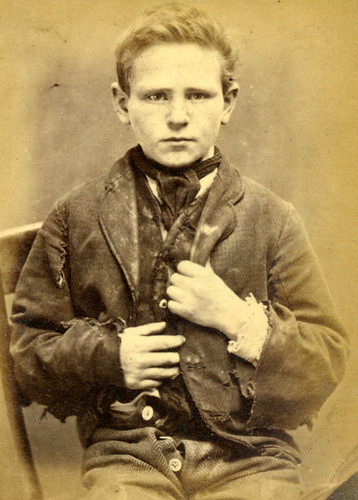
The faces of poverty and crime

I came across this site last night (http://www.flickr.com/photos/twm_news/sets/72157625464218629/with/5287955310/) and clicked through them with a peculiar mixture of fascination and sadness. The faces show emotions from hardness to despair, and overwhelmingly the grind of poverty- and many of them children. The grime, the rags, the destitution. And 140 years later, I feel an incredible pity. Did anyone care about them then, when they needed it?

(Up next: Just for Mardi Gras, info on the dietary practices of medieval Lent)

Friday, February 3, 2012

And now for some poetry...

I have two reasons for making another post so soon after the last one: Firstly, I was shuffling some papers around next to my desk, and came across something I wrote several years ago, and thought "Hey! This was pretty good!" And second, having Keith Richards staring at me every time I pull up my home page... is a little frightening. This poem is written in a medieval style from about 1400 CE, using a form I lifted from something by Thomas Hoccleve.  

Fly, My Words  

Fly, my words, to whom I love 
for I would my affections prove 
lest he should think my feelings false 
or feel my protestations else 
 
 Fly, my pen, and petals write 
of such a flower that brings delight 
the soul of one who sees or smells 
a burst of joy within them wells 
 
Sing, my heart, of joy's embrace  
envision my beloved's face 
those eyes that hold me in their gaze 
do warm desires within me raise 
 
Sing, my heart, of longing's pain 
of time and miles that are our bane 
to look at sky and stars above 
and feel them closer than my love 
 
 Of these I then must make complain: 
 of Presence's pleasure, and absence's pain 
of these this hand is bound to write 
 to thee, my Joy, and my Delight!  
 
Written by Laura Minnick, 2002 Ok, typing it out I'm no longer sure how good it is, but I do remember how difficult it was to not only use the period form, but to also to write in a sort of language style that you might find in something written in the early 15th century. Certainly a good deal more difficult than "There was an old man from Nantucket..." (I also had trouble getting the formatting right on this page. If it looks wrong in your browser, sorry...)

Monday, January 30, 2012

You just know that somewhere,

Keith Richards has a portrait in the closet, and it looks FAAAAABULOUS!

(I've been listening to a lot of Rolling Stones lately...)

Ok, really I just put this up because he makes me feel so much better about my looks, you know? I haven't been well and I'm tired and I just look older every time I look in the mirror. And I had another birthday...

Could be worse I suppose. I could have *not* had a birthday!

Quick recap- Thanksgiving kinda didn't happen, for a variety of reasons. So instead of cooking all day for hordes, I made a nice dinner for James and myself, Cornish hens with a wild rice pilaf, and a pear tart for dessert. Pretty tasty!

Went to Summits 11th Night, and was honored to speak for Tadgh at his elevation.

That Sunday James and I went to breakfast with Wanda and Karl and Linda, and I managed to fall down the very steep and narrow stairs to the ladies' room. It being narrow, allowed me to catch myself so I didn't fall far, and avoided what could have been disaster. I did however break the heel off of one shoe, and caught the other big toe and bent it toward the sole. This did not feel good. By the time I got undressed that night, it was black. So off to the doctor I went. Verdict: broken. There's not much you can do with a broken toe, and they said as much, but that one is really necessary and gets used a lot. And then said that they could fit me with a walking cast, or I could wear hard-soled shoes, such as clogs. Well I wear them quite a bit anyway, so this was not a problem. More about that later.

And I went to see Annie for Christmas! I flew out on the red-eye Christmas Eve, arrived in New York with the milkman. Annie and I goofed off and did nothing all day. The next day we had a party- Phil the Younger brought his mom, Phil the Elder (we have to differentiate them somehow...) and Susan came, and brought Evil Spawn (Brennan) with them, and Eric and Andrea, who are Baron and Baroness of Long Island (can't remember the SCA branch name, and yes, you have to say it Long͜͜͜͜͜geyeland). PtE and Eric and I had an impromptu Laurel meeting (and chased PtY out with a "You can't be in here! This is Sooper Sekrit meeting!" after which we discussed Ovaltine, of course) which was mostly Inter-Kingdom Anthropology. "No really, that's how you have candidate discussions? How weird." PtE made meatloaf, because Annie decreed that there must be meatloaf, and I made Chicken Saupiquet and a pear tart. There was much dessert and lots of booze and we had a lovely time.

The next day PtY and Annie and I had a lovely lunch at a place called Lillie's (www.LilliesNYC.com) which had a lame beer selection (I'm spoiled, being from Portland Oregon) and then his mom met us at the Met, and we attempted to tour the museum. Attempted being the operative word here, because every other vacationing family also attempted to do so. It was PACKED. I only barely got to see the Frankish/DarkAges jewelry and the Byzantine textiles and a little more of the medieval stuff before they chased us out again. When we came out the weather had changed and I believe we found Texas' missing rain. A couple of years' worth. We waded home and had leftovers. And my foot swelled a bit, which I expected. The next day PtY came over and Iso and I watched Phil and Annie make soap. And then they took me to the airport. It was much too short a visit. :-(

On the plane naturally I was seated next to Incredibly Obtuse Woman, who had to leave her seat and return twice during the last half hour of the film that I actually paid cash (first time!) to see, even spilling my drink on me. I was also in close proximity to three families with small children, two of whom appeared to had the crud. Two days later, so did I.

And a week after that it was clear that I had a bacterial infection, so I went to the doctor, and came out with a scrip for BIG BAD ANTIBIOTICS, because I had a sinus infection, both ears infected, and a bit of pneumonia in one lung. Hey, when I get sick I don't do a half-assed job of it!

I was well enough by Midwinter's to drive down to Adiantum and go to the event for a couple of hours. Took a new formal Student- their Baroness, Morrghan. She is a lovely woman and is motivated and is NOT LIKELY TO DROP OFF THE FACE OF THE EARTH, and I think it will be fun working with her. We plan to revisit in a year to see if she wants to be an Apprentice.

I've been mostly really not feeling well since, sleeping weirdly and cranky and groggy the rest of the time. I even overslept and was late for church last week, which I never do.

And after six weeks, my foot still hurts. It should be better by now, I'd think.

I got a new hat- a vibrant red, and a new pair of brown shoes and a new pair of red shoes. Well, all these are resale, but they are new to me! Both pair of shoes are much more comfy than some I have, which are going back to Goodwill as they kill my feet.

I finally broke down and got a cell phone. I did not want to, but it really has become necessary. If you aren't living with me, descended from me, or sleeping with me, you don't get the number. So if you don't already have it, don't bother asking.

I of course have a Harry Potter ringtone. :-)

The latest reading has been Dark Ages theology, in which I discovered a guy who got in trouble and was confined to a monk's cell for the crime of preaching pre-destination. This shocked me- I had not realized that pre-destination was preached until Calvin. Our Priest, Caroline, is a History and Theology professor at PSU, so I asked her about it, and it surprised her too. She said that Augustine sort of talked about it, but I haven't read Augustine for ages. She laughed and admitted that she hasn't either. But now I have to go back and read Augustine, and I am not looking forward to it, as it was a real slog last time. Tolle lege! Tolle lege! Well Tolle yourself, bub! :-P Next up (after Augustine) is more womens' history, I think. Trying to get a bead on how much freedom an unmarried or widowed woman had, outside of the royal family or a convent. Also looking at how much education a woman might have outside an abbey, and how she might exercise it. (How much trouble *can* Liutgard get into, anyway? :-))

Tuesday, November 1, 2011

And now one of my better efforts

(A picture of Abelard's brother Preacher, Dominic, at left)


To make up for the last lugubrious posting, I decided to post some of my better writing.

Some time in 2002, then-Majesties of An Tir, Nicholaus and Alyssia, for reasons known only to God decided that they would expand the sumptuary laws of An Tir to include some that they were familiar with. (That is to say, they'd moved in from another kingdom and thought we needed a dose of the other kingdom's laws.)

I was, as they say, nonplussed.

However, there is a side of me that comes out every once in awhile, who will pick apart something like that, and strip the flesh of a matter until the bare bones are exposed. His name is Abelard the Lesser.

Father Abelard sat down, and with the aid of a number of texts, including Gratian's Decretum, examined the issue carefully. This document is the result.

*****


Unto Their Most Royal Majesties of An Tir; Nicholaus, our Undoubted King, and His Most Gracious and Renowned Queen, Alyssia:

Come now these Greetings from the humble Abelard, known as the Lesser, Clerk and Lawyer in the Order of Preachers (Dominican). God grant His Grace to Your Thrones, and long may Your names be heard in the Halls Of Valor and Good Remembrance. Greetings also, in Courtesy, to Their Royal Highnesses, Davin and Groa, that they may also see and ponder the words I offer to Their Majesties. And to Yourselves I offer: Peace, Wisdom, and Humility be granted to you, in remembrance that to wear the Crown is to be the servant of all the Kingdom, and indeed the most humble of all portions.

And now, to the business of this letter.

I have read the proposed changes to the Sumptuary customs and have spent much time pondering these matters, weighing them carefully, and reading books and treatises such as that have bearing on the matter. First, I must apprise you that though I have nearly 14 years experience in the Society, I have modern education and credentials in medieval history and law customs. I can best give information and advice from my studies. I do hope that they count for something in a historical recreation group such as the Society. Also, I am neither on the 'Steps' nor the 'Cathedral'. Friends will on occasion tell me bits of things, but I have no direct knowledge of the conversations therein, nor of what other members of the populace have to say on the matter.

There is, it would appear to me, to be two issues presented by the proposed changes, these issues being: Custom, and Purpose. I will attempt to address these in turn, for while they can be related and at times entangled, they are- at least in the light of medieval law- separate issues.

As to Custom-

The issue of Custom is to my mind raised by the wording of the proposed 'Sumptuary Customs', in the Introduction thereof, a portion:
"These Customs are a compilation of the traditional sumptuary customs, practices, and restrictions of the Kingdom of An Tir. They are presented here in writing, to preserve the traditions of Our realm, and to serve as a source of information for the people of An Tir."

Having read through the rest of the document, particularly noting the newer additions, I must argue that these are neither Customs, nor An Tirian.

Allow me to explain: Custom, in general, means a long-standing, habitual practice. In particular, it has a very specific meaning in Common Law, and when discussing sumptuary matters, the more specific meaning cannot be ignored. The Common Law consists of two parts- the Lex Scripta, or written law, which is created as statute by rulers, and Leges non Scriptae- Customary Law.

Leges non Scriptae are authoritative and original institutions that are not created by a ruling body setting them to writing, but are grown into use and thereby acquire the force of law. Within these Leges non Scriptae are laws made by Custom and Usages.

Custom as Law is subject to certain qualifications. It is not simply unwritten custom, or an oral tradition. Custom is a long-standing usage that has the force of ordinance (Lex Scripta) where none exists. What constitutes long-standing varies by place and situation. For an act, three repetitions may suffice. In other circumstances, it must be a Custom that goes beyond the remembrances of man- i.e. you might remember your grandfather speaking of observing the custom. In some places there are specific times "Before the reign of the Normans" "Before the ascension of King Richard (I)", etc. I have understood for some time that a 'generation' in the Society is about five years- in which case establishment of true Custom can happen in as little as five to ten years.

As well as length, there must be continuity. For a new custom to abrogate (invalidate) the current one, it must be practiced for at least ten years, without break. And the word 'practiced' brings up the next test:

Intention. For a practice to be a Custom, and have the force of Law as Leges non Scriptae, it must be intended to become a Custom. One does not suddenly wake up one day and find that something they did without thought is now a law. As an example, the modern practice of common law marriage- one of the proofs, should it ever go to court for some reason, is Did the Couple Intend to be Married? Were they living together with the intent of it becoming legal vis-a-vis the Common Law? (In fact this holds true in period Marriage Law as well.)

And lastly, Custom that affects all must be approved by the majority. This is not to say that there is something of democratic process, but that the people have to want to practice the thing, with intention and continuity, for it to become Custom. So it is implicit then that they consent.
If a Custom is written down such as to enlighten newcomers, etc., it must be understood that the strength of the Law is not in the writing- the obliging force and power stems directly from the long custom and use.

Now: the Sumptuary standards under discussion. Are they Custom? I believe not. As to length and continuity of practice, they do not reflect the general current practice. And the additions of course cannot be called Custom, as they are new and externally applied. And lack of current practice would either indicate that they have not been accepted, or that they have been abrogated through lack of observance. As to intention? I do not believe there has been a general intention to establish custom. And there are reasons for this which I will go into later. And the same with general acceptance. And if they are not Custom, they are not likely An Tirian.


And so to Purpose.

The basics of medieval Civil Law (that is Lex Scripta) are generally built upon Roman Civil Law. When there is no ordinance regarding something, the matter falls back up the Customs, or Leges non Scriptae. Having established that the proposed Sumptuary standards are not Custom, they must therefor be ordinance, or Civil Law. According to Isidore's Etymologies, as further recorded in Dicta Gratiani, the creation and nature of Ordinance should be as follows: proper, just, possible, in accordance with nature, in accord with the Custom of the country, suitable to the place and time, necessary, useful, clear so as to not contain hidden deception, and not accommodated to some private individuals, but composed for the common utility of the citizens. Ordinances are instituted when they are promulgated, but they are only confirmed when they have been approved by the usage of those who observe them. Ordinances are abrogated- that is, cancelled and rendered void- by consistent and persistent usages contrary to the ordinance. In light of the requirements of Ordinance and the circumstances of acceptance or abrogation, I must concluded that the proposed Sumptuary standards will not pass these tests and are likely to be abrogated.

Referring back to the Introduction of the aforementioned 'Sumptuary Customs', we find this statement:

"This information is designed to assist the populace in the preparation and use of personal regalia items. These guidelines are intended to further enhance the dignity, estate, and appearance of the people of An Tir, and should be consulted when preparing new items of regalia."

There are records of sumptuary standards in many places and times in SCA period, and they have one overriding thing in common: They are meant to discourage sartorial display, and to further broaden the visual gaps between the social classes. Sumptuary laws by their nature are restrictive, and do not encourage the populace towards the use of regalia, but instead away from it.

To explain a bit- sumptuary laws came about (and persisted) for several purposes. First, they were designed to create a visual distinction between the social orders. Heraldry in its early forms was a part of this, and in part because of that, the various Colleges of Heralds have had the responsibility for creating and maintaining the rules and standards of regalia.

Besides a visual distinction, there is an economic one. Most of the sumptuary standards that we can point to come from the time period after the Black Plague, at a time when the social orders are severely disrupted simply because of the vast numbers of dead. The economy was volatile, there was something of social 'upward mobility' happening, and merchants and townsmen were suddenly behaving and dressing like their betters. A number of laws were passed to try to control this, such as the Ordinance and Statutes of Laborers, in 1349 and 1351 in England. Both were intended to keep the lower orders where they belonged, and to restrict their ability to demand higher wages or to move about seeking a better situation. After this was a Sumptuary Statute Of Edward III, in 1363. It was a direct descendant of the statutory provisions that spawned the earlier labor statutes. The idea of this statute was not only to keep people from looking like their betters, but to keep them from spending too much money doing so- which was diverting money from more productive investments that might help the kingdom get back on its feet, and funneling it into clothing and fripperies, and not inconsequentially, into the weavers and merchants not of England, but of Lille, Bruges, Arras, Venice, etc. There was also more than a little of a sense that the People would spend far too much on frivolous things if they weren't prevented from doing so, and must be prevented by their betters.

Many of the more complicated sumptuary laws (such as those in Renaissance Italy) are distinctly economic- only someone with such-and-such an income may wear this kind of fabric from Lucca, or the number of pearls on an woman's gown may not exceed X unless her husband holds a certain position in the town. One could know one's economic (and by extension, social) class simply by 'reading' their dress. This went of course all the way down into the underclass, where prostitutes were required to wear striped hoods or bells on their tippets- and if they attempted to dress like a higher, more respectable woman (this seems to have involved wearing the veils of a proper married woman), the offender was beaten severely in the public square.

There is a sideline of sumptuary standards that may actually have more to do with the Society than rules about a prostitute's red shoes or pearls of a Roman matron's headdress; and that would be rules for regalia. The regalia guidelines are not meant for daily wear, or festival, or even attendance on a king on a hunt. Regalia are emblems- outward tokens of merit and achievement. They appear to be specifically designed to control what is worn in Royal Court occasions- Coronations, royal weddings, royal baptisms, elevations, the opening of Parliament- not necessarily where one wears the highest fashion, but where the rigid, codified formal attire is worn. (Even today, when you see the robes and chaplet worn as they were 300 years ago- no longer fashion, but now costume.) In this context- and only there- the rules are very specific and detailed.

So, this is known: sumptuary rules prevent people from dressing as their betters, thus reinforcing the social order, and redirecting the economy to more useful things, and it serves a visual cue for specific roles at court.

Now perhaps to look back at An Tir.

Do we actually have a problem with people dressing as their betters? I have not seen behavior that appears that way. And because of the balance of Society awards and individual personae, it would be very difficult to ascertain if there genuinely was a problem. Are people outspending themselves and ruining the kingdom's economy? I dare say that is between their checkbooks and themselves. Indeed, there are a number of clothing and fabric merchants in An Tir who would be glad of the business. So if is not social or economic, the crux must be ceremonial. And there we find it our matter.

The proposed sumptuary standards are not necessarily about sumptuary matters, but are specifically about regalia. And we must examine it with these questions in mind: Is there a problem which must be addressed by this document? Are these matters important? How will they change the visual and social aspect of An Tir? Are these rules An Tirian, and if not, what do they accomplish? To whit: do they follow the precepts of Ordinance?

The section addressing crowns, coronets, and circlets, is standard, with only minor modifications.

The section regarding chains also appears to be standard and unchanged.

The section on Collars of Estate is new, so we ask- is there a problem with these collars that must be addressed? .Having only seen a couple of them, I was not aware that they were an issue. They would be appropriate only with a fairly narrow band of personae. Is it truly important to create guidelines? Does anyone really need a rule? Does making a rule encourage people to make a Collar, and how does it do so? If they want one, why haven't they made one already? And not having seen anything like this in An Tir, where does it come from and how does it benefit us?

The section on chaplets has similar concerns, even more so. Chaplets of fur (of any sort) are specifically ceremonial regalia. You don't wear them to dinner at your Auntie's. They are worn in court, when receiving foreign dignitaries, etc. If anyone in An Tir had them, they would wear them twice a year- at both coronations. There really is not another appropriate time and place. However, that is a very big if. Does anyone in An Tir have a chaplet of fur, much less ermine? I have never seen one. And the only ermine I've ever seen was on Mistress Tessella's tippets. This bit of regalia would be very self-limiting due to expense. And it is not appropriate to wear one if the king is not doing so. Also, like the collars, it is appropriate for a very narrow time and place. The chaplets do eventually freeze and become a 'costume' regalia, but they were worn by the actual court during a very short period of time. This happened also to a particular sort of sideless surcoat, which turns up on portraits of queens long after they were fashionable. Shall we add them to the list of things to regulate?

The chaplets are also not native to An Tir- the notion has been imported from somewhere else. Since it is not in use, and not likely to be in common use (I know it is in the sumptuary laws in other kingdoms, but I asked around- it is not in use there) so why create a rule regarding something that is not used? How will we be benefitted by doing so?

As to spurs, I seem to remember that at one point the specific rule had been that knights may have spurs with rowels, leaving pick spurs to the populace. I being a man of the church, have no particular opinion.

About belts. Here is one item of regalia that has a special problem. It is also a necessary item of clothing. Belts of white have been reserved since time immemorial (and yes, white belts for knights are period- as per careful study, I have concluded that not all knights wore white belts, but if you find a period picture of a man wearing a white belt, chances a very good that he's a knight!). Red belts have, by Custom (and I do mean Custom in the legal sense) been set apart for squires. But the green and yellow belts have been only intermittently used in other kingdoms, and while they have been introduced here, they have not really been accepted in general use. My guesses at why are these- knights and squires both wear belts as part of their ensemble anyway. Laurels and Pelicans may or may not wear belts, and are more likely to have very elaborate clothes that require special waist-wear. An apprentice or protege may not wear a plain leather belt for similar reasons. Many Laurels and Pelicans have their own favors or livery to make note of their students with. Is it truly necessary to mark people with belts in this manner? What does it accomplish? It is my firm belief that if this was meant to be, it will grow into Custom. If not, it will not. In the meantime, do we wish to restrict the clothing options of those of the populace who are not of the Chivalry or in a specific relationship with a peer?

Now back to Purpose.

I have been given to understand that it was Your Majesties' intent to encourage sartorial display, to encourage creation and regular use of regalia, to enhance our experience in the Current Middle Ages through pomp and panoply. I understand and applaud that intent, if that was indeed your meaning. But I cannot believe that the way to best encourage something is to regulate it. I believe that the best way to encourage something is to do it- and do it well. Put your household in livery, have banners and gonfalons made. Think about how to encourage the populace to research the regalia that would be appropriate for their persona, perhaps by the creation of an award, not specifically for persona, but for display of such. I, for instance, may not wear regalia- it would be most inappropriate for a Dominican canon. But I know a woman who has taken her award medallions and mounted them on a fine baldric with gauds and bells, as is appropriate to her early 15th c persona.

It is of course entirely Your Majesties' prerogative to consider my words or to disregard them. But I must add this: As they stand now, the 'Sumptuary Customs of An Tir', being neither Custom nor An Tirian, and specifically noted as not statutory, are quite likely to be received with a most time-honored Custom of An Tir- that is, being ignored. And I do not think that would be any benefit either to Your Majesties, or to An Tir.

Written on this the feast day of St John the Evangelist with the assistance of my scribe, Arundel, but signed by mine own hand,
In all Honesty and Reverence, I remain,

Father Abelard the Lesser, Order of Preachers (Dominican)
*****

They decided not to implement the laws after all. I'm sure this is just a coincidence.

Wednesday, October 26, 2011

The worst paper I ever wrote.

Ok, I've mentioned it in a number of places, so I am offering it up here, so others may view it's full horror. And sorry, but the footnotes can't be copied. I don't know why.

***

Bite Me:

Female mystics, Eucharistic Devotion, and the Corporeal Christ

Woman is to man as body is to soul- in one phrase the sum of much of the philosophy and theology of the Middle Ages. Men were largely seen as linked to the mind and spirit, able to transcend the physical and think creatively or meditate; to worship and interact with God on purely spiritual level. Women on the other hand, not only inhabit but are imprisoned by their bodily nature. They are only a little above the animals, having souls but mostly unable to reach beyond the body, and so trapped in the bodies they inhabit, are by their very nature unable to grasp the supernatural. The divine is invisible, ineffable, ephemeral, and cannot be touched in the bodily sense; so a creature with such a thoroughly grounded bodily nature, with its corresponding desire and need for the physical connection will be denied the desired interaction: for the un-bodied God cannot be reached, be touched, or be connected with by a bodied female.
Given that impasse, with the gulf between the world of the body and of the spirit, visions of God and interactions with Him would then remain in the realm of the symbolic, containing something of the unknowable. However, with some of the female mystics it is their bodily nature, the very thing that holds them back from the realm of the spiritual and therefore from complete union with God, i.e., the body, becomes the vehicle by which they can attain it. In the same way that one who cannot climb up a tree with an armload of lumber, could build a ladder with the lumber, so to scale the tree and reach its branches, so that very nature which distanced them from God became their means of communing with Him.
In the Genesis account, God walked in the garden in the cool of the evening, with the man and woman that he had created. They could commune easily and experience pleasure from this time because there was yet no gulf, no breach in the relationship of spirit and body. When Eve ate of the forbidden fruit, it was a reach for knowledge, which is in the realm of the spirit. Eve's attempt to grasp something of the spiritual through an act of the physical severed the two worlds, and created the division between them.
The phrase "Woman is to man as body is to soul" can also be read as "Woman is to man as humanity is to God". This separation of body and soul and of humanity and God was created by a bodily act, the physical act of Eve. Thus, the act of reparation must of necessity be a bodily one, an extrinsic act of salvation.
The person of Christ , by his very nature and existence, is the bridge between the two worlds, a curious inhabitant of both the liminal and the substantial. While fully God, he is given a body and takes on a cloak of humanity through the woman Mary; through her female body he is given a part of Mary's femaleness, and deep connection with the bodily nature. Thus , as the female body provided the agent of separation of body and soul, or of humanity and God, it is a female body that is the agent through which is provided the means of salvation.
A female mystic might see Christ as that ladder- as the tangible body used to bridge the gap between God and humanity, and indeed the Church saw him in that capacity. From his conception, which moved his existence from solely in the spiritual into one where he fully inhabited both spiritual and physical worlds at once; to the Passion, where he hung between those two worlds until the weight of them pulled him asunder and separated again the spirit from the body; he is that sole link and only connection between the earthly and the holy. Because it is particularly the bodily nature of this link that makes it efficacious, the body itself becomes particularly important. Every member is a rung on that ladder, and every wound or drop of blood imbued with meaning.
In the world of the medieval mystic, the corporeal presence of the risen Christ was embodied in the Holy Eucharist, that small wafer given to the communicant at Communion. The wafer was not just a physical representation of Christ's body, but it was Christ's body; and because Christ was not just a link to God but was also fully God, the eucharist was doubly important. It was sustenance, both physical and spiritual; it could feed the body while it nourished the soul.
Many of the female mystics of the medieval era showed great devotion to the eucharist, and quite a few reached a point in their devotion where they abstained from all other foods. Some reported it melting and tasting like honey in their mouths, others that it turned to blood or to meat that they needed to chew. Others, denied communion for any number of reasons, found that communion was given to them through miraculous means. Still others found their mouths suddenly filling up with the desired wafer, so that they were given their communion without the hand of the priest bestowing it.
The act of communion- that blend of communication and union (it is by no mistake that the recipient is known as the communicant) is central to the mystical experience. In the receiving of the eucharist, that link is established that crosses that liminal space between the earthly and the divine. The physical body of Christ is present in the wafer as is the divine presence, so that when the recipient eats the eucharist, her body and Christ's body become one; she has achieved a brief moment of true union of the corporeal and the spiritual. That the incorporation of Christ into self and self into Christ could be repeated was a mystery, but because of that it was sought repeatedly. The obvious metaphor of sexual union is however only workable on one level- that of the physical, of the wafer mixing with the communicant's body. The total union of the body to the spiritual belongs to the realm of the ineffable.
The bodily nature of the female was in the medieval view of a double nature: more than simply partaking of nourishment and excreting the excess, it could also excrete food. A woman producing breast milk became both eater and the eaten- taking in food and then becoming it herself. Breast milk was also thought to be made of blood, some sort of distillation or by-product of it. Perhaps in part because of this, the close associations of women's bodies with blood via menstruation, and of the production of milk, women were seen as intrinsically linked through their bodily natures to food, to milk, and to blood. It is then not surprising to find so many female mystics to be preoccupied with Christ's bodily nature, or that their preoccupation would be with his body as food, his blood as drink, and the wound in his side as like a breast to nurse from. Indeed as women were linked to the bodily by their excretory and reproductive functions, Christ is linked to the bodily through its salvific function.
It is not only Christ's body that they are preoccupied with, however. Frequently we see the female mystic not only appropriating Christ's body as that connector or touch-point to reach a union with God, but we see her using her own body as an extension; in her own devotional experience, or as part of another woman's devotion, as an adjunct to Christ, an intercessory link to yet another body. Catherine of Siena is well known not only for abstaining from food and sustaining herself only on the eucharist as part of her devotion to Christ, but also for licking the open wounds and sucking the pus from lepers, and sucking at the infected breast of one afflicted woman. In this she becomes not an agent of the bodily, reaching towards the spiritual; but the spiritual reaches through her, using her as an agent to connect with the bodily, much in the way that Christ provides that bridge. This is one expression of the imitatio Christi; not simply in the imitation of his sufferings, or of his life, but of his very existence as agent of reconciliation.
These women are also seen as becoming instruments of their own salvation, as intercessory agents for themselves. This is seen in instances where the particular sin to be expiated was particularly identified in or with a portion of the body, the penitent would administer punishment to that member, such as fasting to remedy the sin of gluttony, or self-administered beatings or mutilations to erase former pleasures. Through this sort of purchase, the mystic is again extending her body towards God, using the same body that sinned as the agent of the remission of that sin.
Whatever body it is that reaches across to bridge that space between the physical and the spiritual, the greatest emphasis remains on the point of contact. Like Michelangelo's hand of God touching man, it is that contact that makes the connection, that allows the communication. Both portions, the physical and the spiritual, are needed for a successful connection to be made between the two worlds. As an electrical current needs a contact to complete a circuit, so the heavenly needs the bodily to contact: hand to hand, mouth to mouth, mouth to breast, flesh to spirit. Through the bodily nature of Christ, the ineffable nature of God can be known to humanity. Humanity, through that union with Christ gained by the eating of the eucharist, can communicate with and be known to God.
***

And this pile of bovine exhaust... got an A.

I lost a great deal of respect for academia after that.